We help you learn quickly so you can play music as you dream of playing.
We help you learn quickly
so you can play music
as you dream of playing.
Practice smarter.
Play better.
Progress sooner.
Practicing music scales can be boring at times.
Spil helps you learn in a way that's fun, not dull.
We can help you become lightning-fast, so that you'll soon be able to play even the hardest pieces of music.
Spil turns scale practice into focused, engaging training that builds speed, accuracy and confidence.
Start for free.
Stay for US$2.99/month.
Free for 14 days.
Cancel anytime.
Subscription is just
US$2.99/month after the trial.
Instead of repeating scales the same way every time, Spil randomizes notes so each session feels fresh.
Like a good game, there's always an element of surprise—and that keeps you engaged.
Because every session is different, you stay focused and improve faster.
Research shows that randomizing practice can dramatically increase learning speed and accuracy.
Athletes have used this approach for decades. Spil brings the same proven method to music practice.
Because notes appear one at a time, you must react instantly—you can't rely on anticipation.
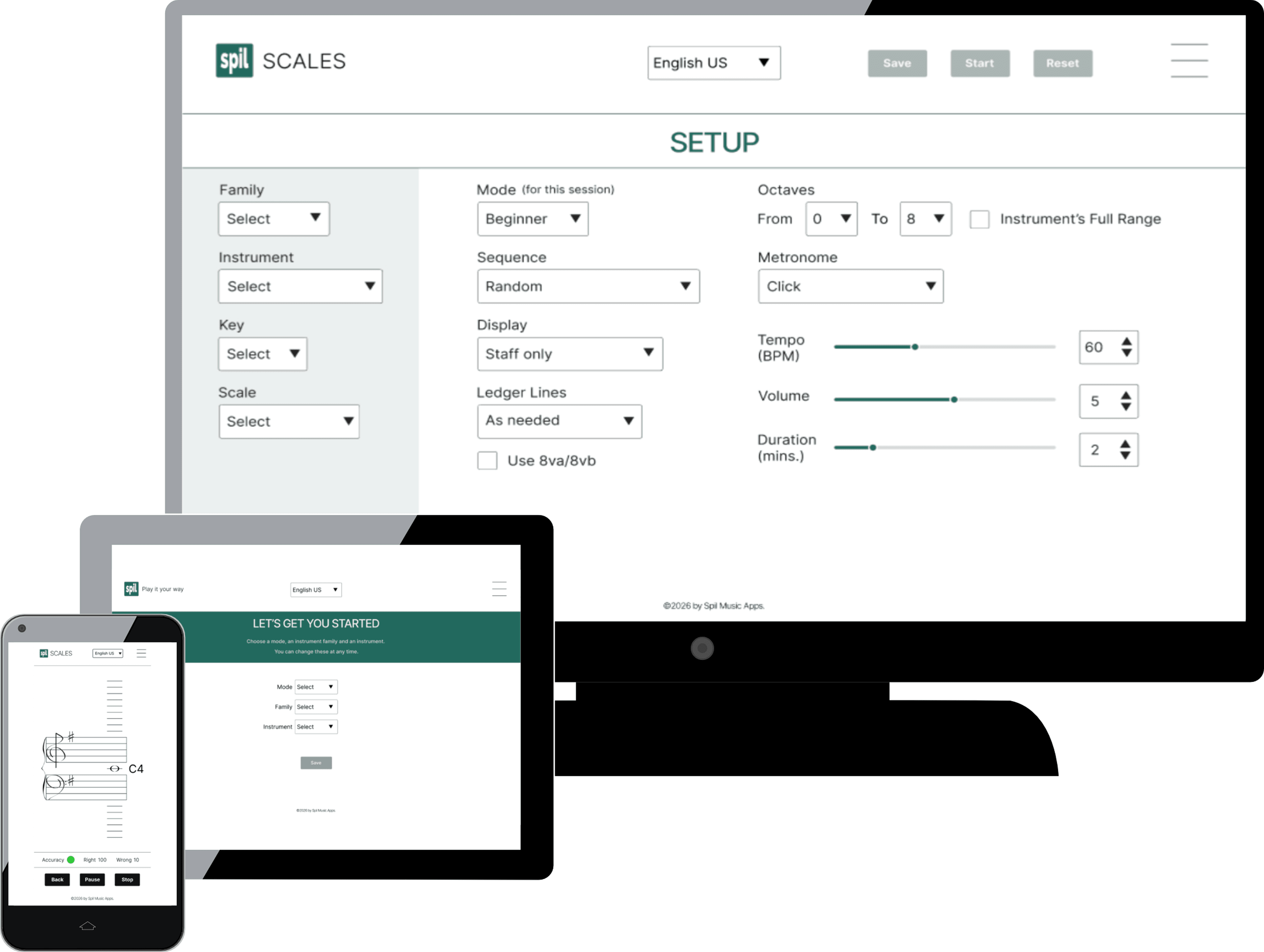
You control the tempo, increasing speed as your technique improves.
Spil tracks how accurately you play and suggests what to practice next based on your goals and level.
You can also see clear progress toward the goals you set.
Set your own practice goals, then let Spil measure your progress as you work toward them.
For beginners, Spil is simple to use and helps you advance quickly.
For intermediates and advanced players, it adds more key signatures, scales, and complexity.
Instead of repeating scales the same way every time, Spil randomizes notes so each session feels fresh.
Like a good game, there's always an element of surprise—and that keeps you engaged.
Research shows that randomizing practice can dramatically increase learning speed and accuracy.
Athletes have used this approach for decades. Spil brings the same proven method to music practice.
The random aspect means you have to react quickly as each note appears one at a time. You can't anticipate.
Spil also lets you set the speed at which you want to practice, so you can increase the tempo when you're ready to make it more challenging.
Spil suggests what to practice next based on your goals, your level, and how accurately you're playing.
Spil will also measure your progress toward achieving the goals you set.
For beginners, Spil can be easy to use and is made to help you advance quickly.
For intermediates, it's more challenging, adding more key signatures and scales.
For advanced or professional musicians, it's all in the tempo and the complexity.
Spil randomizes notes so practice never feels repetitive.
Randomized practice helps you improve accuracy and speed more efficiently.
React to each note as it appears. Increase tempo as you improve.
Spil tracks your accuracy and shows your progress toward the goals you set.
Beginner, intermediate, or advanced—Spil adapts to you.